Key Takeaways
- When Jungkook was discharged from the South Korean military on June 11, 2025, his skin immediately trended globally — and India’s ARMY was at the front of that conversation.
- His documented routine principles — double cleanse, BHA toner, layered hydration, diligent SPF — are clinically sound and form the home foundation of genuine glass skin.
- What the routine content does not show is the clinical layer: the treatments Korean idols receive regularly that maintain the skin’s underlying architecture in a way no home routine alone can replicate.
- Indian skin — Fitzpatrick III–V — is capable of the same glass skin quality. The protocol needs to be calibrated for our melanin content and Mumbai’s specific climate, not copied directly from Korean product lists.
- The most important thing Jungkook’s skin tells us is not which products he uses. It is that consistent, disciplined Korean skincare practice, maintained for years, produces a cumulative result that becomes most visible when the skin is rested and unstressed.
- At Glam Korean Skin Studio, the VVS Glass Skin Treatment translates this principle clinically for Indian skin — using the same Korean aesthetic philosophy, adapted for where we live.
On June 11, 2025, Jeon Jungkook stepped out of a stadium in Yeoncheon, Gyeonggi-do, in his South Korean military uniform, received a bouquet of flowers from a waiting crowd of fans, and smiled at the cameras. Within hours, the photographs were everywhere. The internet, as it tends to do with anything involving BTS, had an immediate and fully formed opinion: he looks impossibly good.
Fans had been watching closely. Jungkook had enlisted in December 2023, completing eighteen months of mandatory military service alongside fellow member Jimin under the buddy system. The discharge photographs that circulated on June 11 — unfiltered, press-shot, real-lighting images — showed a face that looked not just good but notably youthful, clear, and luminous in a way that prompted immediate global trending and a predictable wave of questions: How? What is he using? Can I get that?
As a dermatologist who works specifically with Korean skin protocols and sees Indian skin every day at Glam, I found myself genuinely interested in this conversation — because the actual clinical answer to those questions is more useful and more nuanced than any product recommendation. This blog is that answer.
First: Why Did His Skin Look So Good After 18 Months of Military Service?
Before we talk about his skincare, I want to explain something that I think is the most clinically interesting part of the post-discharge conversation. The immediate assumption was that military service must be terrible for skin — stress, outdoor exposure, limited product access, disrupted sleep. And yet every BTS member who discharged in 2025 looked notably well-rested and clear-skinned. The pattern is not coincidence. It is biology.
18 Months Without Daily Stage Makeup
Performance-level makeup — foundation, concealer, setting products — applied daily and nightly over years creates a continuous cycle of occlusion, congestion, and barrier challenge. During military service, the routine of heavy makeup disappears almost entirely. The skin gets eighteen months of sustained recovery: fewer blocked pores, reduced barrier disruption, lower chronic inflammation from cosmetic ingredients. The barrier that has been managing cosmetic load for years can finally consolidate. This alone produces a meaningful skin quality improvement that shows up clearly in unedited photographs.
Regulated Sleep
Military service enforces something that the K-pop entertainment industry notoriously does not: consistent sleep timing. The skin’s primary repair cycle occurs between 10pm and 2am, driven by a peak in human growth hormone secretion that stimulates cellular renewal. A regulated military sleep schedule means this repair cycle is completing consistently — possibly for the first time in years for someone who had been on the performance circuit since his teens.
Lower Dietary Glycaemic Load
Military rations in the South Korean army are nutritionally regulated and lower in the processed, high-sugar food that is endemic to the entertainment industry’s irregular schedule. Dietary sugar drives glycation — the process by which glucose bonds to collagen and elastin, creating the stiffening and yellowing that makes skin look aged and dull. Eighteen months of lower dietary glycaemic load produces a measurable improvement in skin’s structural quality.
The Foundation Was Already There
This is the most important point. The military discharge photographs were not showing a transformation. They were showing the result of years of disciplined Korean skincare practice, made visible on a face that was finally rested, unstressed, and free of the daily cosmetic and schedule burden of performance life. The skin that appeared on June 11, 2025 was built long before December 2023. The military simply revealed it.
Jungkook’s Documented Routine — The Clinical Analysis
Jungkook has been unusually transparent about his skincare habits across interviews, live streams, and fan-facing content over the years. Here is what is publicly documented — and the clinical reasoning behind each element.
Double Cleansing — Every Night Without Exception
Jungkook uses a gentle, low-pH foam cleanser — specifically documented as the Shiseido Senka Perfect Whip — as part of his cleansing routine. The double cleanse principle (oil-based cleanser first to remove makeup and SPF residue, water-based cleanser second to remove water-soluble impurities) is the most fundamental pillar of Korean skincare and the one that produces the largest single improvement for most skin types when adopted consistently.
For Indian skin in Mumbai, this principle is doubly important. The combination of SPF (non-negotiable for our UV environment), pollution particulate matter, and sebum creates a surface load that a single cleanse — particularly a foaming cleanser used first — simply does not fully remove. A proper double cleanse removes this load completely, giving every subsequent step a clean surface to work on.
BHA Toner — Pore Management and Barrier Support
Jungkook and fellow BTS member V have both referenced using a BHA (salicylic acid) containing toner — an approach that reflects a clinically sophisticated understanding of pore management. BHA is oil-soluble, meaning it penetrates into the sebaceous follicle rather than staying on the skin’s surface. It dissolves the sebum-dead cell mixture that blocks pores from within, making it significantly more effective for congestion-prone and acne-prone skin than physical exfoliation or AHA alone.
For Indian skin, BHA is particularly well-suited. It is anti-inflammatory as well as exfoliating, meaning it reduces the risk of the post-exfoliation irritation that triggers post-inflammatory hyperpigmentation in darker skin tones. For Mumbai’s oily, humid monsoon season — when pore congestion accelerates — a BHA toner two to three times a week is one of the most useful additions to any routine.
Toner and Cream — Morning and Night
In an Allure interview, Jungkook confirmed that he uses toner and cream both morning and night — a layered hydration practice that reflects the Korean principle of building the skin’s water-holding capacity progressively rather than relying on a single occlusive step. The toner delivers the first, lightest hydration layer, adjusting the skin’s pH and priming it for absorption of subsequent steps. The cream provides the final, slightly more occlusive layer that helps seal in the hydration built beneath it.
This structure — lightest to heaviest, water to cream — is the opposite of the Western tendency to apply a single heavy moisturiser. It produces superior hydration because each layer is absorbed into a surface that has already been prepared by the preceding one.
Diet, Hydration, Exercise
Jungkook is publicly known for his fitness regimen — consistent exercise, a diet oriented toward protein and whole foods, and high daily water intake. From a dermatological standpoint, these are not incidental habits. Exercise improves microvascular circulation — the same mechanism responsible for the warmth and vitality in skin that clinical PDRN boosters also target. Adequate hydration supports cellular water retention. And a lower glycaemic diet, as discussed, reduces the collagen-stiffening glycation that makes skin look older than it is. The skin is the external expression of the body’s internal health — and Jungkook’s disciplined approach to both is visible on his face.
Masking — The Korean Ritual Most People Skip
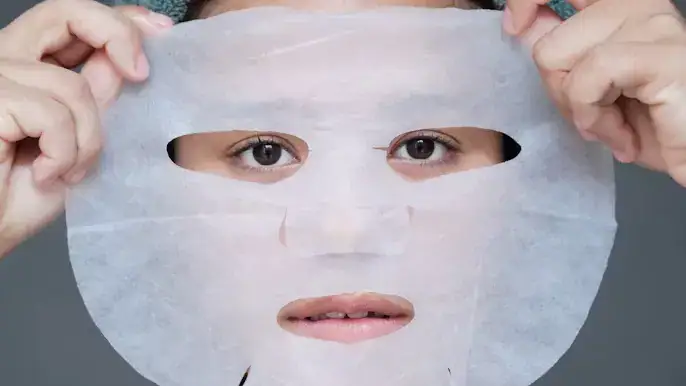
BTS members have been photographed repeatedly with sheet masks — backstage, in hotel rooms, during travel. J-Hope and Suga in particular have been documented masking before significant appearances. For Jungkook, the sheet mask is a hydration-delivery tool: the occlusive film holds a concentrated essence against the skin for fifteen to twenty minutes, allowing the hydrating and brightening ingredients to penetrate more deeply than they would in open-air application. For Indian skin in Mumbai, a hydrating sheet mask twice a week is a simple, accessible ritual that meaningfully supports the layered hydration principle without adding significant complexity or cost.
The Honest Part — What the Routine Content Never Shows
I want to be direct about something that the product-focused Jungkook skincare content consistently omits, because it is the same omission that exists in virtually all celebrity skincare coverage: the routine is not the whole story.
Korean idols — particularly those at BTS’s visibility level — have access to dermatology clinics as a routine professional resource, not a special-occasion indulgence. The skin quality visible on stage, in fancams, in press photographs is maintained by a combination of home routine and regular clinical treatment. The two work together: the home routine maintains the foundation between sessions; the clinical treatments maintain the underlying architecture of the skin that the home routine cannot reach.
What those clinical sessions involve at the Korean clinical level — and at Glam in Mumbai — includes: Hydrafacials to manage the accumulated surface congestion that even a perfect home routine cannot fully prevent; glass skin treatments before major appearances to maximise luminosity; skin booster injections to maintain the deep dermal hydration that produces the plump, taut quality visible under camera; and PDRN boosters to support cellular repair and collagen maintenance over time.
None of this is scandalous or surprising. It is simply the clinical reality of what world-class skin maintenance looks like — and it is worth being honest about, because the implication that a product routine alone can produce what BTS members show on stage sets an expectation that products alone cannot meet. The clinical layer is the difference. And the clinical layer is available in Andheri West.
Translating Jungkook’s Routine for Indian Skin in Mumbai — What Actually Works Here
The principles behind Jungkook’s routine are clinically sound and transferable. The specific products are calibrated for Korean skin in Seoul’s climate, which is different from Indian skin in Mumbai’s climate. Here is the practical translation:
What Transfers Directly
- Double cleansing — identical principle, equally important for Mumbai skin. Oil cleanser first (micellar oil or cleansing balm), gentle low-pH gel cleanser second. Non-negotiable if you wear SPF, which you should be doing daily.
- BHA toner — works the same way on Indian skin; arguably more important given Mumbai’s humidity-driven congestion. Two to three times a week is sufficient. Do not use on the same night as retinol.
- Layered hydration, lightest to heaviest — the sequencing principle is universal. Watery toner, then essence or serum, then moisturiser. In Mumbai’s monsoon, replace the moisturiser with a gel-serum and skip the cream entirely.
- SPF50 daily — Mumbai’s UV is year-round. This is the single habit with the greatest long-term impact on skin quality for Indian skin. Non-negotiable.
What Needs Adapting for Indian Skin
- Apple cider vinegar rinse — Jungkook has mentioned diluting apple cider vinegar in water to rinse his face twice a week for blemish management. As a dermatologist, I want to flag that acetic acid — even diluted — can disrupt the skin’s pH and barrier, particularly in sensitive, melanin-rich skin prone to post-inflammatory hyperpigmentation. For Indian skin, a properly formulated BHA or low-percentage AHA is significantly safer and more effective for the same goal. Please do not pour acid on your face based on an idol mention.
- Product textures for humidity — Korean moisturisers are often formulated for Seoul’s colder, drier climate. In Mumbai’s humidity — particularly June through September — gel-based or water-gel moisturisers prevent the occlusion that cream formulations create in high-humidity conditions. Switch textures seasonally.
- Sheet mask frequency — in Mumbai’s humidity, daily sheet masking can actually create too much occlusion. Two to three times a week is optimal. Choose formulas without heavy oils or thick emollients, which can contribute to congestion in already-oily Mumbai skin.
- Post-inflammatory hyperpigmentation management — Indian skin is significantly more prone to PIH than Korean skin. Any exfoliating step — BHA, AHA, physical exfoliant — needs to be calibrated conservatively and always followed by SPF the following morning. Clinical treatment for established PIH (Trio Peel, pico laser) should not be skipped on the assumption that a brightening serum will resolve it.
“BTS skin is Korean skincare done consistently, by people who take it seriously, over years. The glass skin, the even tone, the luminosity — none of it is accidental, and very little of it is purely genetic.”
What the Clinical Version of Jungkook’s Skincare Looks Like at Glam
The home routine above is the foundation. For skin that wants to actually achieve the glass skin quality that Jungkook’s discharge photographs showed — the luminosity, the even tone, the lit-from-within quality — the clinical layer is what produces it and what maintains it between sessions.
At Glam Korean Skin Studio in Andheri West, the clinical translation of Korean glass skin principles for Indian skin involves:
- VVS Glass Skin Treatment — the clinic’s signature Korean glass skin protocol, adapted for Indian skin. Deep cleansing, Korean-formulation exfoliation, layered hydration, and luminosity finishing in a single session. Immediate and visible result. Most clients book this monthly as their skin maintenance practice.
- Korean Hydrafacial — the three-step protocol that removes Mumbai’s accumulated pollution-congestion layer, exfoliates, and delivers intensive hydration in a single session. The accessible entry point to clinical glass skin treatment, with zero downtime and an immediately visible result.
- Trio Peel — for clients with PIH or uneven tone standing between their skin and the glass skin result. Korean-calibrated for South Asian skin tones. Addresses the pigmentation evenness that the glass skin aesthetic requires.
- PDRN Booster — for the sustained cellular quality that makes glass skin look the same in an unfiltered photograph as it does immediately post-treatment. The treatment that maintains the underlying architecture between sessions.
You do not need to be a K-pop idol to access Korean skin medicine. You need to be in Andheri West.
What India’s ARMY Wants to Know — Answered Honestly
Is Jungkook’s skin genetic or can anyone achieve it?
Both, in honest proportion. Jungkook has naturally good skin genetics — a Fitzpatrick II skin type, relatively low melanin content, and a reportedly low tendency toward hormonal acne. These are advantages that products did not create. However, the specific glass skin quality — the luminosity, the even tone, the clarity — is the result of consistent Korean skincare practice over years, clinical maintenance, and the lifestyle habits described above. The genetic baseline matters. The practice matters more. And for Indian skin, the clinical protocol can close most of the gap that genetics alone would leave open.
Which BTS member’s skin type is closest to Indian skin?
V (Kim Taehyung) has a slightly warmer, more golden skin tone — Fitzpatrick type II to III — that is the closest among the members to the lighter end of Indian skin. RM and Suga are notably fairer. J-Hope’s warmer undertone is also closer to many Indian skin types. The specific member matters less than the protocol: the Korean skincare principles that all seven members follow are applicable to Indian skin when adapted appropriately.
Is there a Korean skin clinic in Mumbai that follows the same protocols Korean idols use?
Yes. Glam Korean Skin Studio in Andheri West is a Korean-method aesthetic clinic led by Dr Akansha Agarwal, who maintains an active clinical relationship with Korean dermatologists in Seoul and regularly updates her protocols from Korean clinical practice. The VVS Glass Skin Treatment, PDRN boosters, and Trio Peel at Glam are the clinical layer — the treatments that translate what Korean skincare does at the home level into what Korean clinics do at the dermal level. For Indian skin. In Mumbai.
What is the single most important thing from Jungkook’s routine that Indian skin should adopt?
Daily SPF50, applied generously, every single morning, regardless of whether you are staying indoors or the sky is overcast. This is the single habit with the greatest long-term impact on skin quality — more than any serum, any treatment, any routine adjustment. Mumbai’s UV is year-round and cumulative. The pigmentation, dullness, and structural ageing that SPF prevents is far harder and more expensive to correct than it is to avoid. Jungkook wears SPF. So should every Mumbai resident, every morning, without exception.
BTS is reuniting as a group in 2025. Will we see even better skin?
Clinically speaking — almost certainly. The full BTS group reunion in 2025, with all seven members discharged by late June, means the return to active schedules and performance life. But the skin quality each member brings back from their military service is a high baseline — rested, repaired, carrying the accumulated benefit of years of Korean skincare practice. The return to clinical maintenance routines will maintain and build on that baseline. For India’s ARMY, the answer to “will their skin keep looking this good” is: yes, because the discipline that produced the result is still there.
The Korean Approach to Skin Is Not a Fan Fantasy. It Is a Clinical Method Available in Andheri West.
Jungkook’s skin is not a mystery. It is the visible outcome of Korean skincare philosophy — barrier-first, layered hydration, consistent protection, clinical maintenance — applied with discipline over years. The same philosophy, adapted for Indian skin and Mumbai’s climate, is what Dr Akansha practices at Glam Korean Skin Studio every day. The VVS Glass Skin Treatment is the closest clinical translation of what Korean idol skincare produces — built for Indian skin, not borrowed from a Seoul product list.
India’s ARMY knows that the best things take consistency. Skin is no different.
Book a Glass Skin Consultation at Glam Korean Skin Studio, Andheri West →
Aston Building, 802, Lokhandwala Rd, above Mercedes showroom, Sundervan Complex, Shastri Nagar, Andheri West, Mumbai 400053
+91 93269 69657 ·
Get Directions
Ready to begin your Korean skin journey?
Book a consultation with Dr Akansha and the team at Glam.
Enquire on WhatsApp