Key Takeaways
- Skin ageing at the cellular level is driven by three converging mechanisms: NAD+ depletion (the decline in the coenzyme that powers every cellular process), mitochondrial dysfunction (reduced cellular energy production), and telomere shortening (the progressive erosion of the chromosomal caps that regulate cellular lifespan).
- NAD+ levels begin declining from the mid-twenties and are significantly reduced by the mid-thirties — a timeline that precisely corresponds to when Indian professionals notice their skincare stopping working.
- NMN (Nicotinamide Mononucleotide) is the most bioavailable direct precursor to NAD+. Peer-reviewed research on human skin fibroblasts confirms it activates sirtuin pathways, suppresses cellular senescence, and supports extracellular matrix integrity.
- Telomere shortening in skin cells accelerates under oxidative stress — meaning Mumbai’s UV and pollution load ages Indian skin at the chromosomal level faster than chronological age alone would predict.
- The NAD+ · NMN · Telomuse Complex sourced from CosmoBeauty Seoul 2026 addresses all three mechanisms in a single clinical protocol — available now at Glam Korean Skin Studio, Andheri West.
- This is not a better serum. It is a different category of intervention — one that works at the biological layer where the cause of the skincare plateau is actually located.
I want to write this blog for a specific reader: the person who has done their research, understands their actives, has tried everything the content-led skincare world has recommended, and wants to know what is actually happening inside their skin at the level that those products cannot reach.
This is the clinical explanation of skin ageing that most dermatology content omits — not because it is too complex to communicate, but because the treatments that address it have only recently become accessible outside of research settings and advanced Korean clinical practice. The NAD+ · NMN · Telomuse Complex that I sourced from CosmoBeauty Seoul 2026 and introduced at Glam is the clinical translation of this science into a treatment available in Andheri West. Understanding the science is the best way to understand why this treatment exists and who it is for.
The Three Biological Mechanisms of Cellular Skin Ageing
Mechanism 1: NAD+ Depletion — The Cell’s Energy Crisis
Nicotinamide Adenine Dinucleotide (NAD+) is a coenzyme found in every living cell. It is not an ingredient. It is a fundamental biological molecule without which cellular life cannot function. NAD+ serves three critical roles in skin cell biology:
- Energy metabolism: NAD+ is the electron carrier in the mitochondrial processes that produce ATP — the energy currency that powers every cellular function from protein synthesis to membrane repair. Without adequate NAD+, mitochondria produce less ATP, and every energy-dependent cellular process slows.
- Sirtuin activation: Sirtuins are a family of proteins that regulate cellular ageing, DNA repair, inflammation suppression, and stress response. They require NAD+ as a cofactor to function. As NAD+ declines, sirtuin activity falls with it — reducing the cell’s capacity to repair DNA damage, control inflammatory signals, and maintain the collagen scaffold of the dermis.
- DNA repair: PARP (Poly ADP-ribose polymerase) enzymes, which repair the DNA strand breaks caused by UV radiation and environmental toxins, consume NAD+ in the repair process. In an environment like Mumbai’s — with year-round UV and high particulate pollution — the daily DNA damage load is substantial, and the NAD+ consumed in repairing it is substantial. Over years, this cumulative consumption contributes to the declining NAD+ pool.
Research published in the Journal of Cosmetic Dermatology (2025) confirms this directly: NAD+ levels decrease with age, leading to age-associated functional decline, and one of the mechanisms of skin ageing is a decrease in NAD+ levels — with research showing that increasing NAD+ levels prevents skin ageing phenotypes. This is not a supplement company’s marketing claim. It is a peer-reviewed finding with mechanistic specificity.
The timeline of NAD+ decline is precisely relevant for Mumbai’s working professional population: levels begin declining from the mid-twenties and are measurably reduced by the mid-thirties. This is the decade in which skin begins to look different in photographs. This is when the products that worked in the twenties begin to plateau. This is not coincidence. It is biochemistry.
Mechanism 2: Mitochondrial Dysfunction — The Power Stations Losing Efficiency
Mitochondria — the organelles within cells that convert nutrients into energy through oxidative phosphorylation — decline in both number and efficiency with age, and decline faster under oxidative stress from UV and environmental pollution. The consequences for skin are direct: less cellular energy means slower collagen synthesis, reduced barrier repair rate, impaired cellular renewal, and a reduced capacity to respond to the actives in a skincare routine.
The mitochondrial connection to NAD+ is circular and reinforcing: NAD+ is essential for mitochondrial function; mitochondrial dysfunction reduces NAD+ production; reduced NAD+ further impairs mitochondrial function. This loop accelerates once it begins — which is one reason the cellular ageing that starts slowly in the late twenties tends to accelerate noticeably in the mid-thirties.
For Indian skin in Mumbai specifically, the oxidative stress generated by PM2.5 and PM10 pollution is a significant accelerant of mitochondrial dysfunction. The free radicals generated by urban particulate matter deposit in skin cells and directly damage mitochondrial DNA — which has limited repair capacity compared to nuclear DNA. Over years of daily urban exposure, this mitochondrial damage accumulates, and the cellular energy deficit it produces is part of what makes Mumbai skin look older than its chronological age would predict.
Mechanism 3: Telomere Shortening — The Chromosomal Clock Running Down
Telomeres are protective sequences of repeated DNA (TTAGGG in humans) at the ends of every chromosome, functioning like the plastic tips on shoelaces — preventing chromosomal ends from fraying and fusing. Each time a cell divides, the telomeres shorten slightly, because the DNA replication machinery cannot fully copy the very ends of chromosomes. When telomeres become critically short, the cell enters a state called replicative senescence: it stops dividing and begins releasing a cocktail of inflammatory cytokines and proteases collectively called the Senescence-Associated Secretory Phenotype (SASP).
SASP is the cellular equivalent of a neighbourhood going into decline: the senescent cell’s inflammatory secretions damage the surrounding tissue, accelerate ageing in neighbouring cells, and degrade the extracellular matrix — the collagen and elastin scaffold — that gives skin its structure. In skin, the accumulation of senescent cells is one of the primary drivers of the structural ageing visible in the thirties and forties: the loss of firmness, the deepening of lines, the reduction in the tautness that characterises younger skin.
Critically for Indian skin in Mumbai: telomere shortening accelerates under oxidative stress. UV radiation, pollution-generated free radicals, and the psychological stress of an intense professional environment all accelerate telomere erosion beyond the chronological rate. Mumbai skin at 38 may have the cellular telomere profile of skin at 44 in a less stressful environment — and the structural ageing that follows from that accelerated erosion is real and visible.
The NAD+ · NMN · Telomuse Complex — How It Addresses All Three Mechanisms
The three mechanisms above — NAD+ depletion, mitochondrial dysfunction, and telomere shortening — are not independent. They interact, amplify each other, and together produce the cellular ageing that no topical product reaches. The clinical value of the NAD+ · NMN · Telomuse Complex is that it addresses all three in a single protocol, through components with complementary and synergistic mechanisms.
NAD+ — Direct Replenishment
The NAD+ component delivers the coenzyme directly to skin cells in a liposomal formulation that significantly improves bioavailability. Research published in PMC confirms that liposomal NAD+ effectively reaches skin fibroblasts and keratinocytes, reducing cellular senescence markers and restoring energy metabolism. This direct replenishment addresses the energy deficit immediately — providing the cellular fuel that sirtuin activation, DNA repair, and collagen synthesis all depend on.
NMN — Sustained NAD+ Production Through the Biosynthetic Pathway
NMN (Nicotinamide Mononucleotide) is converted to NAD+ through the cell’s own biosynthetic machinery — specifically through the NAMPT enzyme in the salvage pathway. This means NMN does not just deliver NAD+; it enables the cell to produce NAD+ itself, restoring not just the molecule but the cellular system that manufactures and maintains it. Research on human skin fibroblasts published in the PMC database confirms that NMN treatment produces distinct gene expression patterns, activates sirtuin and autophagy pathways, enhances mitochondrial function, suppresses cellular senescence, and supports extracellular matrix integrity. For skin collagen and elastin — which are produced by fibroblasts — these are directly visible consequences.
Telomuse Complex — Telomere Support and SASP Reduction
The Telomuse Complex supports telomere maintenance through multiple mechanisms: providing the nucleotide substrates that telomerase (the enzyme that rebuilds telomere sequences) requires; reducing the oxidative stress that accelerates telomere erosion; and modulating the SASP inflammatory signals that senescent cells release into surrounding tissue. The result is a reduction in the rate of telomere shortening — extending cellular functional lifespan — and a reduction in the tissue-damaging inflammatory environment that accumulated senescent cells create. This is the mechanism most directly responsible for the structural quality improvement — the firmness, tautness, and reduction in the visible signs of structural ageing — that the treatment produces over successive sessions.
“NMN significantly elevated cellular NAD+ levels, activated sirtuin and autophagy pathways, and enhanced mitochondrial function, collectively maintaining cellular homeostasis under stress. Furthermore, it suppressed cellular senescence, promoted cell proliferation, supported extracellular matrix integrity, and accelerated wound healing.”
Who This Treatment Is For — The Clinical Decision Framework
The NAD+ · NMN · Telomuse Complex is the most targeted anti-ageing intervention at Glam for clients in the mid-thirties to fifties. But it is not for everyone, and being specific about the right candidate matters more than broad appeal.
This treatment is most appropriate for:
- Skin that has plateaued despite a good routine — specifically, skin that has not responded meaningfully to well-selected products for three or more months. This plateau is the clinical signature of the cellular capacity deficit the treatment addresses.
- Urban professionals with high environmental stress load — Mumbai’s UV and pollution environment accelerates NAD+ depletion and telomere shortening beyond the chronological norm. The treatment’s mechanisms are directly targeted at these environmental accelerants.
- Clients showing early structural decline — the loss of plumpness, beginning laxity, a dullness that is deeper than surface congestion — these are the signatures of cellular energy decline and early senescence accumulation.
- Clients whose PDRN programme has produced good results but is beginning to level off — PDRN and the NAD+/NMN complex address different biological depths. Combining them addresses both the tissue-level inflammatory dimension (PDRN) and the cellular energy and genetic maintenance dimension (NAD+/NMN).
This treatment is less appropriate for:
- Skin in the early to mid-twenties — the cellular energy system is generally still robust and the priority is UV protection and barrier maintenance rather than cellular restoration
- Skin with active inflammation or infection — the cellular environment must be stable for the treatment’s mechanisms to produce their intended results
- Clients whose primary concerns are surface pigmentation or congestion — for these concerns, the Korean Pigmentation Correction Therapy and Hydrafacial are more targeted and immediately effective
Every treatment programme at Glam begins with a clinical assessment. The decision about whether the NAD+ · NMN · Telomuse Complex is appropriate for your skin is made after Dr Akansha has assessed your Fitzpatrick type, barrier condition, and specific concern profile — not before.
The Questions Clients Ask About This Treatment
Is this the same as taking NMN supplements?
Related but different. Oral NMN supplements deliver NMN systemically — through the digestive tract, into the bloodstream, and to cells throughout the body. The skin receives a proportion of this systemic NMN, but the concentration that reaches skin cells through oral supplementation is a fraction of what is delivered directly to the skin through the clinical protocol. The NAD+ · NMN · Telomuse Complex at Glam is a skin-targeted delivery — designed to restore NAD+ levels specifically in skin fibroblasts and keratinocytes at concentrations that produce the clinical results described in the research above. Oral supplementation and clinical treatment are complementary rather than interchangeable.
How does this treatment feel and is there any downtime?
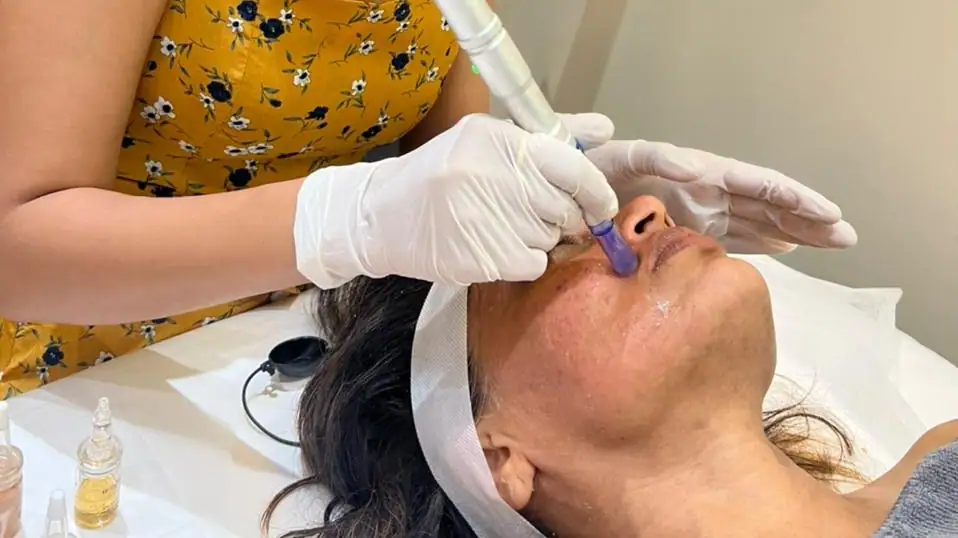
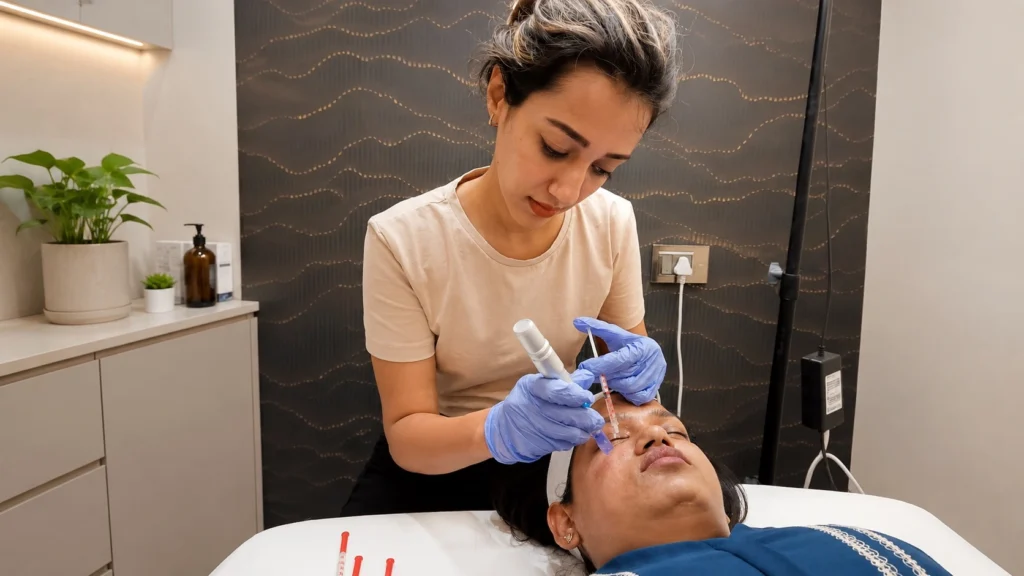
The NAD+ · NMN · Telomuse Complex is administered as a series of micro-injections after topical numbing cream — the same procedure as PDRN booster administration. Most clients describe the sensation as mild pressure. Post-treatment, mild redness resolves within two to four hours. There is no significant downtime. Most clients return to work the same day.
How many sessions do I need and how often?
A standard programme involves three sessions spaced four weeks apart, followed by maintenance sessions every three to four months. The progressive timeline reflects the biological mechanism: cellular NAD+ restoration and the consequent improvements in sirtuin activity, mitochondrial function, and senescence reduction develop over weeks as the cellular processes produce their visible consequences. Results are typically noticeable within three to four weeks of the first session, with continued improvement across a full programme.
Can I combine this with PDRN treatment?
Yes — and for many clients, this combination produces a more comprehensive result than either treatment alone. PDRN addresses the tissue-level and inflammatory dimension; NAD+/NMN addresses the cellular energy and genetic maintenance dimension. Together, they work at two different biological depths, which is why the combined programme is particularly appropriate for Mumbai skin dealing with both the environmental damage that PDRN targets and the cellular energy decline that NAD+/NMN addresses. The combination is planned at the consultation level — the sequencing and spacing of the two treatments are designed by Dr Akansha based on your skin’s current condition and treatment goals.
The Skincare Plateau Has a Clinical Explanation — And Now a Clinical Solution
The mechanisms described in this blog are not theoretical. They are happening in your skin cells right now if you are in your mid-thirties or beyond and living in Mumbai’s environmental context. The plateau your routine has hit is not a product selection problem. It is a cellular energy problem — and cellular energy problems require cellular solutions.
The NAD+ · NMN · Telomuse Complex, sourced directly from CosmoBeauty Seoul 2026 and available now at Glam Korean Skin Studio in Andheri West, is the most scientifically precise response to this specific problem that is currently available in Mumbai. The consultation that determines whether it is appropriate for your skin is forty-five minutes. The biological shift it produces is measurable, visible, and — for the clients I have already treated with it — something they describe as their skin finally responding again.
Book a Consultation at Glam Korean Skin Studio, Andheri West →
Aston Building, 802, Lokhandwala Rd, above Mercedes showroom, Sundervan Complex, Shastri Nagar, Andheri West, Mumbai 400053
+91 93269 69657 ·
Get Directions
Ready to begin your Korean skin journey?
Book a consultation with Dr Akansha and the team at Glam.
Enquire on WhatsApp