Key Takeaways
- Jisoo’s Netflix drama Boyfriend on Demand premiered March 6, 2026 — and her skin across the series generated as much conversation as the show itself among India’s BLACKPINK fanbase.
- What fans are seeing in Boyfriend on Demand is years of consistent Korean skincare practice and clinical maintenance made visible under studio-quality lighting — not a specific product or a recent treatment.
- Jisoo’s skin type (Fitzpatrick II) is different from Indian skin (Fitzpatrick III–V) — which means the clinical protocol for achieving the same glass skin quality requires calibration for Indian melanin content, not a direct copy of Korean idol routines.
- Indian skin at its best produces a glass skin quality that is distinctly its own — warmer, richer, and deeper in luminosity than Fitzpatrick II glass skin. The goal is not to replicate Jisoo’s skin. It is to achieve the best version of your own.
- The VVS Glass Skin Treatment, PDRN + VB Complex, and Korean Skin Rejuvenation Treatment at Glam — updated from CosmoBeauty Seoul 2026 — are the clinical tools for this outcome.
- Jisoo being a Dior Beauty ambassador means her public appearances reflect premium professional aesthetic maintenance. What she shows on screen is achievable — not because your skin is like hers, but because the biological principles that produce it are universal.
Boyfriend on Demand arrived on Netflix on March 6, 2026, and gave India’s BLACKPINK fans what they had been waiting for: Jisoo in a full leading role, ten episodes, and close-up camera work that made the conversation about her skin almost inevitable.
BLACKPINK has one of India’s largest K-pop fanbases, and Jisoo’s combination of K-pop visibility and now K-drama leading-lady status places her at the intersection of two enormous Indian audience segments. The searches that followed Boyfriend on Demand were predictable: plot summaries, Jisoo and Seo In-guk chemistry discussions, and — among skincare-aware fans — queries about her skin that ranged from “what does Jisoo use for glass skin” to “how do I get skin like Jisoo in Boyfriend on Demand.”
As a dermatologist who attended CosmoBeauty Seoul 2026 in late May and works specifically with Korean skin protocols, I find the Jisoo skin conversation genuinely interesting — not because the answer is a product list, but because the clinical explanation behind what she shows on screen is the same explanation behind what every glass skin treatment at Glam is designed to produce. The biology is transferable. The protocol needs to be calibrated for Indian skin. The outcome — your skin at its best — is achievable.
What Jisoo’s Skin in Boyfriend on Demand Actually Shows
The specific quality that generated the most fan conversation about Jisoo’s skin in Boyfriend on Demand is the evenness. Not the luminosity alone — though that is present and striking in several scenes — but the absence of visible variation: no patches, no uneven tone around the nose and chin, no difference in clarity between the forehead and the lower face. In close-up shots under studio lighting, Jisoo’s skin reads as uniformly clear across the entire face.
Clinically, this kind of uniform clarity in a 29-year-old performer with years of stage makeup and schedule demands behind her is the result of three things working simultaneously:
- An established and consistent barrier health practice — the Korean skincare philosophy of ceramide-led moisturisation and gentle pH-balanced cleansing, maintained over years, produces a barrier that holds hydration efficiently and resists the inflammation that creates uneven tone
- Regular professional clinical maintenance — glass skin treatments, Korean peels, and skin booster protocols that maintain the surface luminosity, cellular hydration, and pigmentation evenness that studio lighting reveals with unforgiving precision
- Rigorous sun protection — Jisoo’s career has kept her largely indoors or under carefully controlled lighting, and Korean SPF culture means she is protected when she is outdoors. The cumulative effect of years without significant UV-driven pigmentation accumulation is visible in the even, clear tone that Boyfriend on Demand shows
The show’s production also deserves acknowledgement: high-quality cinematography, professional lighting design, and Korean makeup artistry at its best are part of the picture. But the skin quality that makeup and lighting are working with is genuine — and distinguishably different from scenes in lesser-produced Korean content where similar technical resources are applied to less well-maintained skin.
The BLACKPINK-Dior Connection — What It Tells Us About Professional Skin Maintenance
Jisoo’s status as a Dior Beauty global ambassador is worth noting clinically — not for the products it implies, but for what it represents about the level of professional skin maintenance accessible to BLACKPINK members at this stage of their careers.
Global luxury brand ambassadors in the K-pop and K-drama space maintain their skin at the level their brand partnerships demand. This means regular access to Korean aesthetic clinics at a frequency and standard that most consumers do not match — glass skin treatments before major brand appearances and shoots, skin booster injections for hydration maintenance, and the full range of Korean regenerative protocols as standard professional infrastructure. The skin Jisoo shows in Boyfriend on Demand is not the result of the products she promotes. It is the result of the clinical maintenance programme that her professional position makes available to her as a professional necessity.
This is not a criticism. It is the same honest framing I applied in the Jungkook and Wonyoung blogs earlier in this series: understanding the full picture of what produces the skin you are admiring is more useful than a curated product list that tells half the story. And the full picture, in this case, is clinically accessible in Andheri West.
The Indian Skin Translation — Why Your Version Is Worth Wanting
Jisoo is Fitzpatrick type II — medium-fair, with a warm undertone and relatively low melanin content. Indian skin is predominantly Fitzpatrick III to V — a different melanin distribution that changes both the challenges and the opportunities of glass skin as an aesthetic goal.
The challenges: higher melanin content means greater risk of post-inflammatory hyperpigmentation from treatments not calibrated for darker skin, and a tendency to accumulate UV-driven pigmentation faster than lighter skin. These are the concerns I covered in detail in Blog 9 of this series, and they require Korean-calibrated protocols rather than direct application of protocols designed for Fitzpatrick II skin.
The opportunity — and this is what I want to emphasise, because it is genuinely understated in K-beauty content: Indian skin at its best produces a glass skin quality that Fitzpatrick II skin cannot replicate. The depth of luminosity in well-maintained dark Indian skin, the warmth, the richness — these are not lesser versions of Jisoo’s glass skin. They are a different and distinctly beautiful expression of the same clinical goal. When a client of mine with Fitzpatrick IV skin achieves glass skin through a consistent programme, the result is not pale and mirror-like. It is deep and luminous and warm — and consistently described by their colleagues and family members as transformative in a way that is hard to attribute to a specific change.
The goal is not to achieve Jisoo’s skin. It is to achieve the best possible version of your own — and at Glam, the Korean protocols adapted for Indian skin are the clinical tools for exactly that.
The Clinical Programme for Glass Skin in Indian Skin — What Glam Does
The glass skin programme at Glam Korean Skin Studio has been updated following Dr Akansha’s attendance at CosmoBeauty Seoul 2026. Here is the current clinical framework:
The Foundation — VVS Glass Skin Treatment
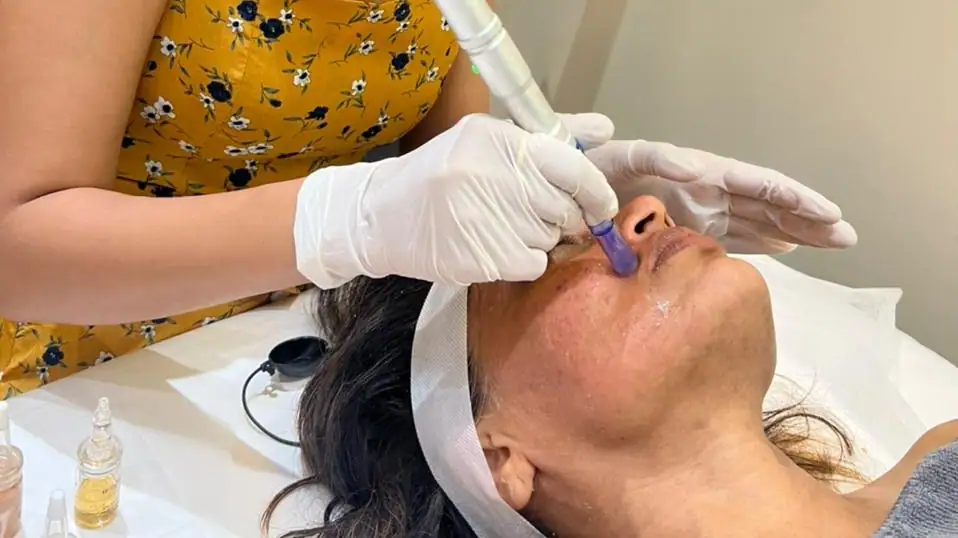
The VVS (Visible Vibrant Skin) Glass Skin Treatment is Glam’s signature Korean glass skin protocol, adapted specifically for Indian skin. It combines deep cleansing to remove Mumbai’s accumulated pollution layer, Korean-formulation exfoliation calibrated for Fitzpatrick III–V skin, layered hydration using Korean essences and serums, and luminosity-enhancing finishing steps. A single session produces an immediately visible result — skin that appears clearer, more hydrated, and more luminous than when the client arrived. Most clients book this monthly as their skin maintenance practice.
The Enhancement — PDRN + VB Complex
For clients whose glass skin goal requires more than surface luminosity — whose skin needs cellular repair from accumulated urban damage, brightening from the vitamin B components, and the anti-inflammatory benefit of PDRN to prevent the melanocyte overstimulation that creates uneven tone in Indian skin — the PDRN + VB Complex introduced from CosmoBeauty Seoul 2026 adds the clinical depth that the VVS treatment’s surface-level protocol does not reach. The combination of VVS Glass Skin monthly and PDRN + VB Complex quarterly produces a sustained glass skin quality that clients consistently describe as the most visible and lasting improvement in their skin they have experienced.
The Correction — Korean Pigmentation Correction Therapy
For clients with significant PIH or uneven tone standing between their skin and the even-tone quality that glass skin requires, the Korean Pigmentation Correction Therapy (introduced from CosmoBeauty Seoul 2026) is the treatment that addresses this barrier specifically. Once the pigmentation evenness improves — typically over three to four sessions — the VVS Glass Skin Treatment produces a more dramatic visible result because the canvas it is working on is more even.
The Maintenance — Home Routine Calibrated for Mumbai
- Double cleanse every evening — oil cleanser then gentle gel cleanser
- Korean toner — first hydration layer, adjusting skin pH
- Niacinamide serum — melanin transfer inhibition, barrier support
- Lightweight gel moisturiser — appropriate for Mumbai humidity
- SPF50 every morning — the most important step in the entire programme
“The series will let viewers vicariously experience exciting romance through the characters. I think it will be a fun treat for anyone who feels worn down by the monotony of everyday life.”
Jisoo was describing the drama. But the same sentiment — experiencing something that lifts the quality of everyday life — is what clients at Glam describe when they talk about what their skin means to them. The connection between skin confidence and how daily life feels is not trivial. It is why people book, and why they return.
What BLACKPINK Fans Want to Know About Glass Skin
I watched Boyfriend on Demand and searched every product Jisoo has been associated with. None of them produced the glass skin I saw in the show. Why?
Because the glass skin visible in Boyfriend on Demand is not primarily a product result. It is the outcome of years of Korean skincare discipline plus regular clinical maintenance — the two layers working together. The products Jisoo promotes create and maintain the foundation; the clinical treatments maintain the underlying skin quality that the foundation depends on. Searching for the product that produces what you see on screen is searching for the publicly visible half of the equation. The clinical half is what Glam provides.
Is Jisoo’s skin naturally this good or has she had treatments?
Almost certainly both. Jisoo’s natural skin genetics — Fitzpatrick II, relatively low melanin, and a reportedly calm baseline sebaceous activity — give her a favourable starting point. But the specific glass skin quality visible in Boyfriend on Demand is not a genetic outcome. It is the result of the practice described above: consistent Korean skincare, regular clinical maintenance, and the professional infrastructure of a career that treats skin health as a professional necessity. To the extent that this question implies genetics alone produce this result — they do not. Practice, product, and clinical treatment produce it.
Are there any BLACKPINK members whose skin type is closer to Indian skin?
Lisa (from Thailand) has a slightly warmer skin tone that is closest among the BLACKPINK members to the lighter end of Indian Fitzpatrick types — approximately Fitzpatrick III. Jennie has a similar Fitzpatrick II to III range with a cool-neutral undertone. The practical implication for Indian fans seeking to learn from BLACKPINK skincare is the same as it is for all K-pop skincare reference: the principles transfer, the specific product formulations need calibration, and the clinical protocols require adaptation for Indian melanin content and Mumbai’s climate.
I have been a BLACKPINK fan since their debut and have followed every skincare recommendation. My skin has not changed significantly. What should I do differently?
The Glass Skin You Saw in Boyfriend on Demand Is Achievable — In Indian Skin, In Andheri West
Jisoo’s skin in Boyfriend on Demand is a compelling reference point for what Korean skin protocols consistently maintained over years produce — and it is a reference point that Glam Korean Skin Studio is specifically equipped to translate for Indian skin in Mumbai. The VVS Glass Skin Treatment, the PDRN + VB Complex from CosmoBeauty Seoul 2026, and the full glass skin programme are available now. The consultation that determines which programme is appropriate for your skin is forty-five minutes. The skin quality that follows is built across the months and years of consistent care that all the glass skin you admire in K-drama represents.
Book a Glass Skin Consultation at Glam Korean Skin Studio, Andheri West →
Aston Building, 802, Lokhandwala Rd, above Mercedes showroom, Sundervan Complex, Shastri Nagar, Andheri West, Mumbai 400053
+91 93269 69657 ·
Get Directions
Book a Consultation at Glam Korean Skin Studio, Andheri West →
Aston Building, 802, Lokhandwala Rd, above Mercedes showroom, Sundervan Complex, Shastri Nagar, Andheri West, Mumbai 400053
+91 93269 69657 ·
Get Directions
Ready to begin your Korean skin journey?
Book a consultation with Dr Akansha and the team at Glam.
Enquire on WhatsApp